A maker has a drawer of finished earrings and no shop yet. How to start a jewelry business: cost each piece properly, pick one main sales channel, and register before the first sale.
The wider groundwork is the same as for any launch, so the hub on how to start a creative business covers it. This guide stays with jewelry costs, materials, channels and registration.
Common misconceptions before you launch
The first misconception is that a large market guarantees room for a new brand. Amazon says the jewelry industry is growing and expected to be worth over $266 billion by 2027. A US Chamber of Commerce article projects $58.9 billion by 2027. Two projections that far apart are background, not a plan. Amazon also notes that selling jewelry is competitive, and it points sellers to product photos, SEO and A+ Content as ways to stand out. Build the launch on your own costs and a clearly defined customer rather than on a market-size headline.
The table sets three more common assumptions against what the evidence supports.
| Misconception | What holds up | Planning use |
|---|---|---|
| Doubling the cost of supplies gives a workable price | Doubling supplies cost is not profitable. One maker formula multiplies materials plus packaging by 4, adds pro-rated labor, then adds 10% overhead. | Price from a formula that includes labor and overhead, not from materials alone. |
| Wholesale can match the retail price | Wholesale and consignment prices are typically 50% to 60% of the retail price. | Set the retail price so a boutique or consignment sale still leaves a margin. |
| A marketplace shop is all you need | Etsy or Amazon is a reasonable place to start, but your own store on Shopify, Squarespace or Wix is most likely the better long-term route. | Use a marketplace to test demand and build an owned store alongside it. |
The pricing figures come from Jewelry Making Journal’s pricing formula, and the channel advice from the US Chamber of Commerce guide.
Two further assumptions are worth dropping early:
- “Price depends on craftsmanship alone.” Material choice drives price. Amazon notes that plated silver and cubic zirconia tend to cost less than gold and diamonds. Flourish Thrive Academy puts costume jewelry usually under $100 and fine jewelry anywhere from $100 to $3,000 or more. Decide which tier you are in before you buy materials.
- “Handmade listings need no approval.” On Amazon, some types of jewelry require approval to sell. Check this before you build a launch plan around that channel.
Business plan, brand name and registration
A plan you will actually use
A typical business plan, as Flourish Thrive Academy lists it, includes an executive summary, company description, market research, product details, marketing and sales, funding, a forecast and an appendix. For a one-person jewelry brand, the market research, product details and forecast sections matter most. They force you to name a customer, a price tier and a monthly sales target before you commit money to materials.
Registering in Italy
Registration is where the Italian route differs from most English-language launch guides. Italian makers should confirm the route for their activity with Agenzia delle Entrate and their local Chamber of Commerce, and check the structure with an accountant before the first sale. Liability matters when you choose that structure. A US-framed guide warns that a sole proprietorship offers no liability protection and can put personal assets at risk. Ask your accountant how the Italian options compare on this point.
Open a separate bank account for the business as well, so personal and business expenses stay apart and your costing reflects reality.
Materials, suppliers and making
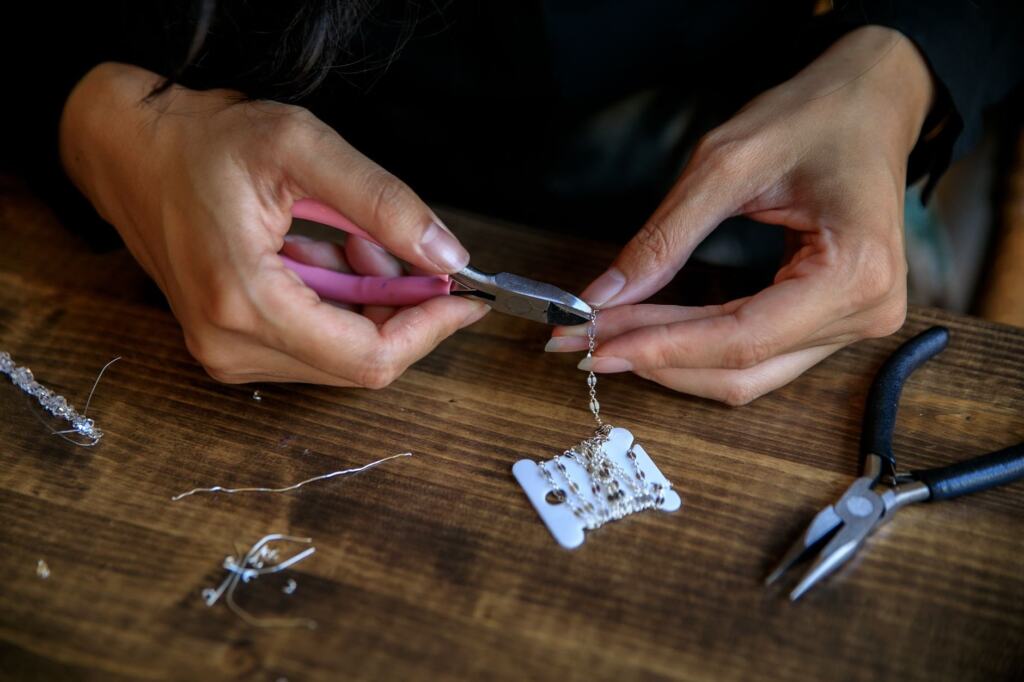
Amazon describes three common sourcing models: connecting with a reliable wholesaler, working with a manufacturer to produce your own designs, or creating jewelry by hand. Handmade production suits a maker who wants full control of the design and can accept limited volume. A manufacturer suits a maker whose design already sells and who needs more units. A wholesaler suits a retailer who curates other people’s pieces. Pick one model for the first collection, because each has different cost and quality risks.
If you use a manufacturer, the US Chamber of Commerce advises you to request samples before ordering any items in bulk. Judge the samples on finish and consistency before you commit money to a run. For handmade pieces, the same discipline applies to your own prototypes. Make a small batch, wear and handle it, and only then buy materials in larger quantities.
Costing and pricing handmade jewelry
Pricing handmade jewelry starts with a repeatable formula. Jewelry Making Journal sets the base price as follows:
- Materials and packaging: add the cost of materials and packaging, then multiply by 4.
- Labor: add your pro-rated hourly labor rate for the time the piece takes.
- Overhead: add 10% for overhead.
The journal’s necklace example uses $5 of supplies, $1 of packaging and 30 minutes of labor at $20 an hour. That gives a base price of $37.40, rounded to $37. Treat the example as a method, not a market price. Your multiplier and hourly rate have to survive a comparison with what similar makers charge. The US Chamber of Commerce recommends spending time on market research to see what other jewelry companies charge before you set a price.
Margins also have to absorb more than the goods themselves. Amazon tells jewelry sellers to calculate margins by taking into account the cost of procuring the goods, storage, shipping or fulfillment, and other factors such as insurance. If a price only works when those costs are ignored, raise it or change the design.
Where to sell handmade jewelry
Choose one primary channel and add others only when the first is running smoothly. The main options compare as follows:
- Your own store on Shopify. The US Chamber of Commerce names Shopify, Squarespace or Wix as most likely the better route than marketplaces. It suits makers who want to own the customer relationship and the brand presentation. Check each platform’s current pricing page before you decide, because monthly plans and payment fees change.
- Amazon. Amazon’s Individual plan might suit a seller with a few pieces of fashion jewelry. A Professional account costs $39.99/month plus selling fees. Own-brand sellers are directed to the Professional plan and Brand Registry. Cost-per-click product listing ads can drive traffic to listings, which adds a further cost.
- Amazon Handmade. This program is described as an online community of artisans from over 80 countries. It suits makers whose work is genuinely handmade and who want a marketplace framed around that.
- Wholesale and consignment. These can add reach through boutiques, at the lower prices shown in the table above. They suit makers who can produce repeat quantities without running out of time.
Amazon reports that small and medium-sized businesses on its marketplace generate about $200,000 in sales per seller on average. That figure covers all categories, so do not treat it as a jewelry forecast.
Whatever you pick, your brand identity travels with you: the same name, photography style and product wording on every listing. Amazon recommends product photos, SEO and A+ Content to differentiate offers, and the photography skills are the same for your own store. If you plan to shoot your own pictures, How To Start A Photography Business: A Practical 2026 Roadmap For New Photographers covers that craft. Makers who also sell digital files can read How To Sell Digital Art Online: A Practical 2026 Guide To Finding Buyers, Pricing, And Getting Paid.
Startup costs, packaging and shipping
Use the checklist below to total your launch costs before you buy anything. It combines the overhead categories Jewelry Making Journal lists with the fulfillment costs Amazon highlights:
- Tools and displays. Pliers, wire cutters and a bench setup, plus displays for markets or photography.
- Website and merchant fees. Your store subscription and the payment processing charged on each sale.
- Insurance. Listed by both sources as a cost to include in margins.
- Materials and packaging. The cost of goods per piece, including whatever the customer receives in the parcel.
- Storage and shipping. Where stock is kept and how orders reach the customer, including fulfillment costs.
- Samples. Test pieces from suppliers before bulk orders.
Put each line in a spreadsheet next to your expected first-month sales. Decide in advance which costs belong in the per-piece price and which belong in overhead, so that you do not count anything twice.
Frequently asked questions
| Question | Answer |
|---|---|
| Where can I find a free business plan template? | Sites such as Score.org and Bplans offer comprehensive templates free to use. |
| How long should a jewelry brand name be? | The same guide recommends names of two to four syllables, which keeps the name easy to say, remember and type into a search bar. |
| Is jewelry easy to ship? | Amazon says that jewelry tends to be small and light, which is good news for logistics. You still need to price packaging and shipping into each order. |
| Can I use Amazon for my own-brand jewelry? | Yes, but Amazon points own-brand sellers to a Professional plan and enrollment in Brand Registry, and some jewelry types need approval first. |