Picture a ceramics studio that films a polished kiln tour and gets views but no enquiries. A brand storytelling video works differently: it puts a customer’s problem at the centre and shows the brand as the guide who helps solve it.
Treat it as one tool within how to market a creative business. The sections below correct common misunderstandings, then cover planning, a modest budget and measurement.
What a brand storytelling video is
A brand storytelling video presents a brand through a short narrative instead of a list of features or offers. Creatify’s guide to video storytelling describes a good story as one with a clear structure: a beginning, middle and end, relatable characters, a conflict and a resolution. The same guide ties emotional elements to how well a video is remembered, which is the main reason to choose a story over a plain product demonstration.
That makes the format a good fit when the aim is to be remembered and understood, such as explaining why a studio exists or what changes for a customer who works with it. It is a poor fit for a price-led promotion with one offer, where a direct message does the job faster. Most wasted effort comes from a handful of assumptions, set against the evidence below.
| Common assumption | What the guidance supports | Planning use |
|---|---|---|
| The brand should be the hero | The customer is the hero, and the brand acts as the guide | Open on the customer’s problem and bring the brand in as the helper. |
| Film first and find the story in the edit | The core problem-solving narrative is defined before a script is written or a camera is touched | Settle the narrative in plain words before booking time, people or kit. |
| Any run of attractive clips is a story | A story has a beginning, middle and end, relatable characters, a conflict and a resolution | Check each draft against those parts before editing begins. |
| Each platform needs its own unrelated video | Marketing and stories should be integrated across channels | Build one story and adapt its cuts to each channel. |
The contrast draws on Creatify’s video storytelling guidance and MyPromoVideos’ strategy guide on brand story examples.
Choosing the hero and the problem
The most useful correction is the first row of the table. A small creative business often wants to talk about its own craft, materials and history, because those are the things it knows best. The guidance says the opposite: the customer is the hero and the brand is the guide. A video about a jeweller’s soldering technique is a demonstration. A video about someone who could not find a ring that matched their story, and what changed, is a narrative.
- Name the problem in the customer’s terms. Describe what the customer was trying to do and what stood in the way, not what the product contains.
- Keep the brand in a supporting role. The brand appears when it helps, and the resolution shows the customer’s situation improving.
- Write the narrative as a sentence before the script. If the problem and its resolution do not fit in a sentence or two, the video is likely to wander.
Planning the story
Planning is where a modest budget is won or lost, because every decision made on paper is a decision that does not need a second shoot. The order that the guidance supports is audience, narrative, then script and camera.
Settle the audience and the narrative first
Creatify advises primary and secondary research to build customer profiles, naming surveys, focus groups and market reports as examples. A small business can apply this at its own scale by asking existing customers what problem brought them in and what they were worried about before buying. Those answers become the conflict in the story, and they are more reliable than a guess made in a brainstorm.
MyPromoVideos makes the sequencing point plainly: define the core problem-solving narrative before the team touches a camera or writes a script. That narrative is the test for every later choice, including location, casting and what gets cut.
Video structure checklist
Use this order to check a script or storyboard before filming. It follows the structure described by Creatify.
- Beginning: introduce a relatable character in a situation the audience recognises.
- Middle: show the conflict, a specific problem the character cannot easily solve alone.
- End: show the resolution, with the brand acting as the guide that helps the character through.
- Throughout: keep a consistent brand voice and message, which Creatify calls crucial for effective storytelling.
A short closing line gives the viewer something to carry away, and Movie Tagline Examples: Bold One‑Liners and How To Write Them In 2026 shows how bold one-liners are built.
Making the video on a modest budget
A story video does not need a large production. What it needs is a plan that gets more than one asset out of each shoot day. Jungle Films’ brand storytelling examples describe capturing footage in one production day for a flagship brand film, short social cuts, vertical reels, testimonial segments and behind-the-scenes clips.
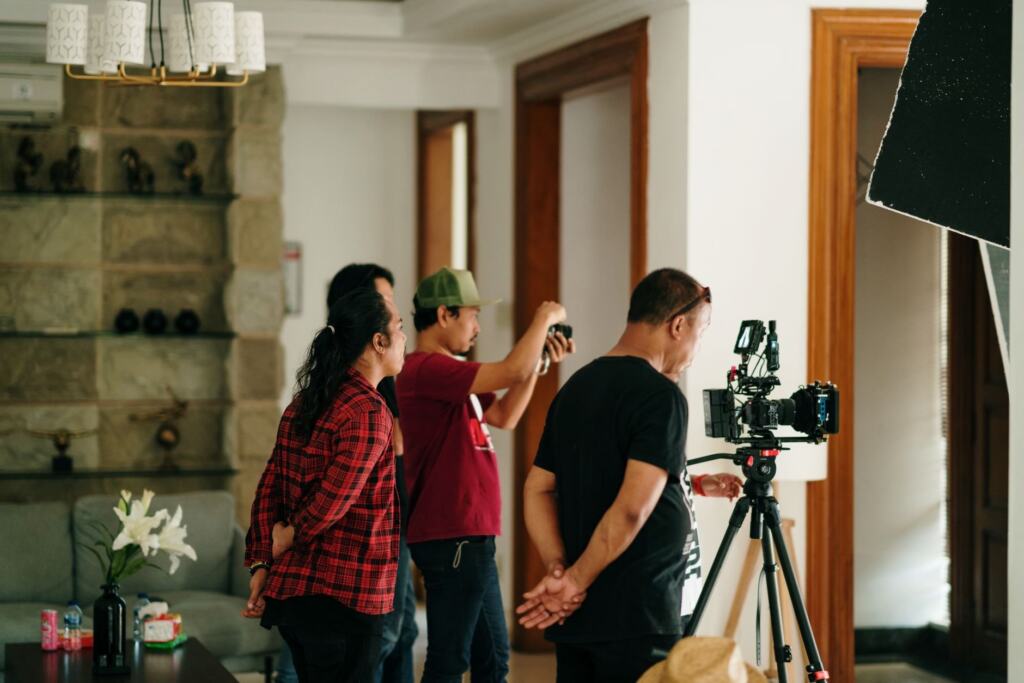
- List the cuts before you shoot. Knowing that vertical reels and testimonial segments are needed changes how you frame shots and how long you hold an interview.
- Cut short captioned clips for social feeds. The same source recommends short, captioned clips that highlight key moments for Instagram, LinkedIn or TikTok, so the story reaches people who will not watch a longer film.
- Use a concrete detail as the emotional anchor. A nonprofit case in the same source framed its appeal around the specific cost of $2.82 to feed a hungry neighbor, and that specificity drove donor emotion. A studio can do the same with a real, specific moment rather than a general claim.
- Put people ahead of jargon. A further case, from professional services, led with people facing challenges rather than legal jargon or case statistics. Any craft business with technical vocabulary can borrow that instinct.
Retail owners can pair the video with the in-store tactics in 27 Low-Budget Marketing Ideas For Small Retail Businesses In 2026 — Practical Tactics To Drive Foot Traffic And Sales, so that the story is seen where customers already shop.
Measuring results
Measurement answers whether the story did the job it was made for. Jungle Films recommends pairing quantitative data with qualitative feedback, because numbers show what happened and comments explain why. The metrics list below follows that approach.
- Retention: how long viewers stay engaged, or watch time. It shows whether the opening and the middle of the story hold attention.
- Sentiment: comments, shares and reactions, which reveal whether the emotional tone resonated as intended.
- Conversions: actions taken after watching, such as newsletter sign-ups, donations or consultation bookings.
- Assisted results: increases in branded search, repeat visits or event attendance tied to the campaign period.
Matching the metric to the purpose
Pick the one or two measures that fit the reason for the video rather than watching everything at once. A studio that sells consultations should look at conversions first and read comments to learn what hesitation remained. A business telling its origin story to build recognition is better served by retention and assisted results, since a direct sale may come later. Assisted results show a link to the campaign period, not proof that the video alone caused the change, so read them alongside the comments that viewers leave.
Frequently asked questions
| Question | Answer |
|---|---|
| Which emotions can a brand storytelling video use? | Creatify cites fear, joy, sadness and disgust as emotional elements that help a video stick. Choose the one that matches the customer’s problem rather than adding emotion for its own sake. |
| Should the video tell the founder’s story? | It can start there. Creatify suggests going back to the beginning, with the founding inspiration and early challenges, as raw material for the brand story. Keep the customer as the hero when you shape it. |
| Why does a consistent voice matter across several videos? | Creatify calls a consistent brand voice and message crucial for effective storytelling, so each new video builds on the last instead of starting from nothing. |
| Does a story approach suit professional services? | Yes. A case from Jungle Films focused on people facing challenges rather than legal jargon or case statistics, which kept a technical field human and easy to follow. |