| Tactic | Cost and effort | Planning use |
|---|---|---|
| Google Business Profile | Free to set up; verification by postcard or phone takes about a week | Start here. Verification runs in the background while you work on everything else. |
| Online directory listings | Free to be listed; name, address and phone number must be identical on every site | Add them after the profile, and treat consistency as a rule, not a preference. |
| Review replies | Reply to every review, good or bad | A small recurring task. Build it into your closing routine. |
| Local media | Many options are free or low-cost | Try these before paying for any advertising. |
| Local influencers | Collaborations with local (not national) influencers can be well worth it | Suits a small brand whose customers live nearby. |
| Overall budget | Low-cost means under $50 a month in the agency’s guide | Use it as a ceiling for paid items, not a target to reach. |
Figures and conditions in the table come from the Indoor Media low-cost marketing guide and the Greensboro Chamber’s small business marketing guide.
The best marketing ideas for small retail business owners combine a free Google listing, a window and display that stops passers-by, and local partnerships. Add tactics gradually and keep paid spend modest.
This page is about the physical shop or stall. For the wider picture of how to market a creative business, including brand and audience work, start with the hub guide.
Shop front and display choices
The cheapest foot traffic comes from the pavement, because a window and entrance cost nothing beyond your time. Entrepreneur’s retail guidance advises designing displays to highlight your best products, seasonal items or current promotions. It also suggests placing related products close together so customers pick up complementary items.

A display supplier’s compilation, MVP Visuals, reports that many millennials choose where to shop based on the in-store experience. It also reports that Gen Z shoppers visit stores frequently. The practical consequence is that regular visitors reward a shop that looks different each time they pass. A display left unchanged for a season gives them little reason to step in.
The same supplier reports that many shoppers will still walk if the line is long. For a small shop with one till, that makes counter flow part of marketing. If the till is also your workbench, keep it clear at busy times.
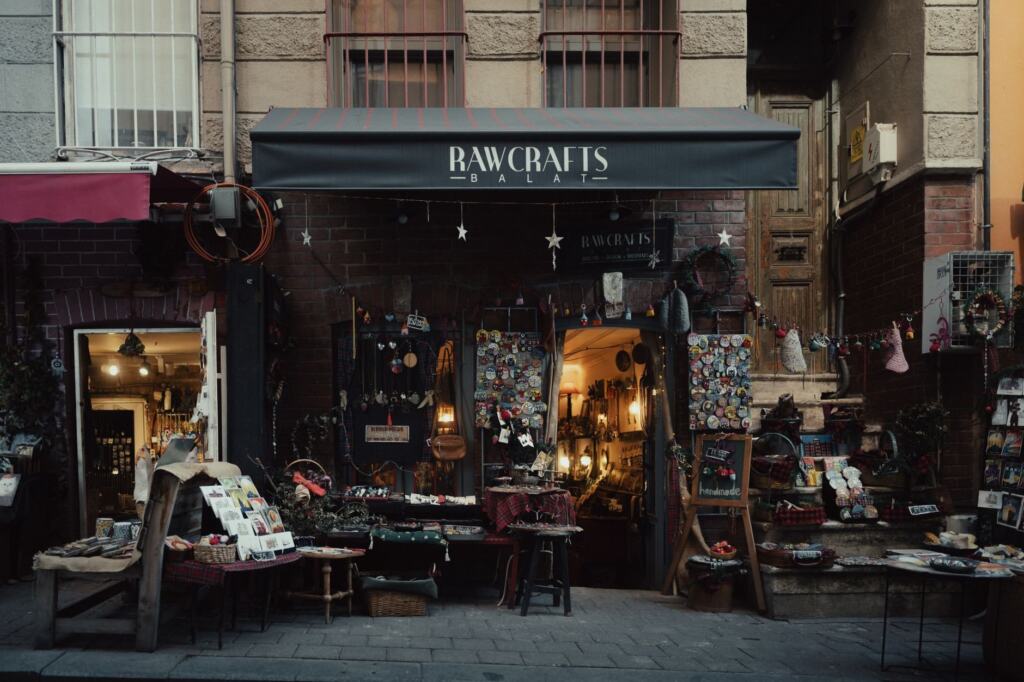
- Lead with best sellers and seasonal pieces. The window works as an advertisement, so put what you most want people to ask about at the front.
- Pair related items. Setting a complementary product beside a popular one makes the add-on purchase easy without any extra spend.
- Keep the counter uncluttered. Impulse items belong near the till only if they do not slow it down.
- Refresh the display before it goes stale. Regulars notice change, and the effort is only rearranging stock you already own.
Local search and your Google listing
Local SEO is the cheapest way to be found by people already looking for a shop nearby. The Greensboro Chamber notes that a Google Business Profile is free to set up and lets Google users immediately see your website, hours, location and phone number. Entrepreneur likewise recommends including those details, and says geo-specific targeting can drive more customers to a physical storefront.
The consequence for a stall holder or a shop with irregular hours is that the profile has to stay accurate. A searcher who finds the wrong opening time will not make the trip. Update the hours whenever you open late, close early or take a market day.
- Keep your details identical everywhere. Indoor Media states that your name, address and phone number must be exactly the same on every site, and that listing on directories is free. Choose one spelling of the shop name and address and copy it every time.
- Reply to reviews. The same guide advises replying to every review, good or bad. A prompt, courteous reply costs nothing and shows other readers how you treat customers.
- Ask for feedback in the shop. A sign at the venue encourages happy customers to leave a review. Place it where people wait or pay, not on the street side of the door.
Instagram, video and email
Instagram gives a maker a free shop window that reaches beyond the street. Entrepreneur points out that Meta’s platforms have more than three billion monthly active users, so the audience exists. The Greensboro Chamber suggests pairing written content with short video on TikTok, YouTube Shorts, Facebook Stories and Instagram Reels.
For a craft shop, short video suits the work itself: a piece being made, finished or used. People who see a process are more likely to understand why a handmade price is fair. If you want to go deeper on narrative, Brand Storytelling Video: How To Craft Videos That Build Loyalty And Boost Conversions (2026 Guide) covers how to build loyalty through video. For ideas beyond the shop front, 50 Proven Content Marketing Ideas To Grow Traffic And Leads In 2026 offers a wider menu.
An email newsletter turns a one-off visitor into a repeat customer. Indoor Media describes drip email campaigns as automated sequences that engage customers based on specific actions. For a small shop, that could mean a welcome message after someone signs up, followed by a note about new work. Only ask for addresses with clear consent. A short, useful message that mentions what is new in the shop will outperform a long catalogue.
Markets, pop-ups and partnerships
A pop-up market lets a maker meet customers who would never walk past the shop, at a cost far below a lease. A display supplier notes that retractable banners and a rolling table make a pop-up activation fast to deploy and simple to move. For a stall holder, that means a light, repeatable kit decides how many markets you can realistically attend. A banner that shows your shop name and street also sends market visitors back to the premises.
- Library and community partners. Indoor Media says that partnering with libraries and similar bodies offers various avenues for community engagement. A talk or demonstration there puts your work in front of local people for little cost.
- Local media. The Greensboro Chamber says many local media options can be free or low-cost. A community notice or listing about a new range or event is a sensible first step.
- Local influencers. The same guide says that, unlike national influencers, collaborating with local ones can be well worth it for a small brand. Choose people whose followers could actually walk into your shop.
Checking what works
Decide in advance how you will tell which tactic worked. Asking new customers how they heard of you is the simplest method, and it costs nothing. Compare the answers with what you did that month: a market, a post, a new window or a mention in local media. Repeat what brought people in, and drop what did not before you spend on it.
Frequently asked questions
How do I get foot traffic cheaply?
Begin with the free items: an accurate Google profile and directory listings, then a display that changes with the season. Add a local partnership or market stall, and treat paid promotion as optional, keeping it within the agency’s low-cost ceiling of under $50 a month.
Which tactics suit a craft shop?
Tactics that let people see and handle the work suit a craft shop best: pairing related pieces, a pop-up table at local markets, and short video of making or using items. Local influencers and community venues such as libraries also fit a business whose customers live nearby.
Do I need to pay for Instagram advertising?
No. Posting short video costs only time. If you do choose to advertise, Entrepreneur notes that Meta’s ad tools can target by location, interests and shopping behaviour, which keeps a local budget focused on nearby people.
Is it worth verifying a Google Business Profile?
Yes. The Greensboro Chamber cites Google as saying that verified businesses are twice as likely to be considered reputable. Verification by postcard or phone takes about a week, so start it early.